October 5, 2026
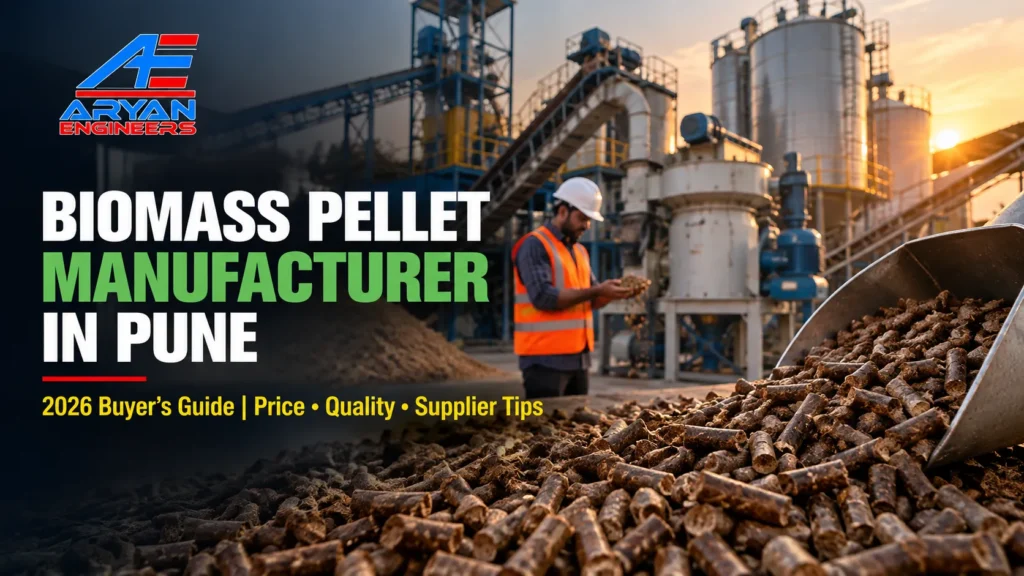
A reliable biomass pellet manufacturer is now central to how Indian industries cut fuel costs and meet emission norms. Whether you run a boiler in Pune, a textile unit in Maharashtra, or a power plant elsewhere in India, the supplier you choose decides your fuel quality, your boiler efficiency, and your bottom line.
This guide covers how pellets are made, what they cost, how to compare suppliers, and what to check before you sign a contract. It is written for plant managers, procurement heads, and entrepreneurs who want facts rather than sales talk.
Quick answer: A biomass pellet manufacturer converts agricultural and forestry residues such as sawdust, rice husk, groundnut shell, and bagasse into dense, uniform fuel pellets. In India, pellets typically sell between ₹5,000 and ₹16,000 per tonne, depending on grade, calorific value, and location.
Table of Contents
- What Is a Biomass Pellet Manufacturer?
- Why Biomass Pellet Demand Is Rising in India
- How Biomass Pellets Are Made: The Manufacturing Process
- Types of Biomass Pellets and Their Specifications
- Biomass Pellet Price in India
- Biomass Pellet Manufacturer in Maharashtra
- Biomass Pellet Manufacturer in Pune
- How to Choose the Best Biomass Pellet Manufacturer in India
- Applications of Biomass Pellets
- Biomass Pellets vs Coal, Firewood, and Diesel
- Challenges to Know Before You Buy
- Starting Your Own Biomass Pellet Plant
- Frequently Asked Questions (FAQs)
- Conclusion and Get a Free Quote
What Is a Biomass Pellet Manufacturer?
A biomass pellet manufacturer is a company that processes organic waste into compressed solid fuel. The product is a small cylinder, usually 6–8 mm in diameter, that burns cleanly in boilers, furnaces, and power plants.
Pelletization converts biomass into high-density solid energy carriers, and the pellets are made to regional or international standards such as European standards or ISO. That is why a professional biomass pellet manufacturer controls raw material, moisture, size, and ash content at every step.
A good biomass pellet manufacturer in India typically offers:
- Pellets made from one or several feedstocks
- Consistent calorific value (GCV) and low moisture
- Bulk supply with scheduled delivery
- Lab test reports for each batch
- Technical support for boiler and burner compatibility
Why Biomass Pellet Demand Is Rising in India
Three forces are driving demand for every biomass pellet manufacturer in India.
- Government co-firing policy. The Ministry of Power revised its co-firing policy in June 2023, requiring 5% biomass co-firing from FY 2024–25 and 7% from FY 2025–26.
- A large supply gap. India produces roughly 2.5 million tonnes of pellets a year, while meeting the co-firing mandates may need 15–20 million tonnes. That gap favours established suppliers with consistent quality.
- Industrial cost and compliance pressure. Factories want a fuel cheaper than diesel or LPG and with a lower carbon footprint. Pellets deliver both.
Therefore, choosing a dependable biomass pellet manufacturer is a strategic decision, not just a purchase.
How Biomass Pellets Are Made: The Manufacturing Process
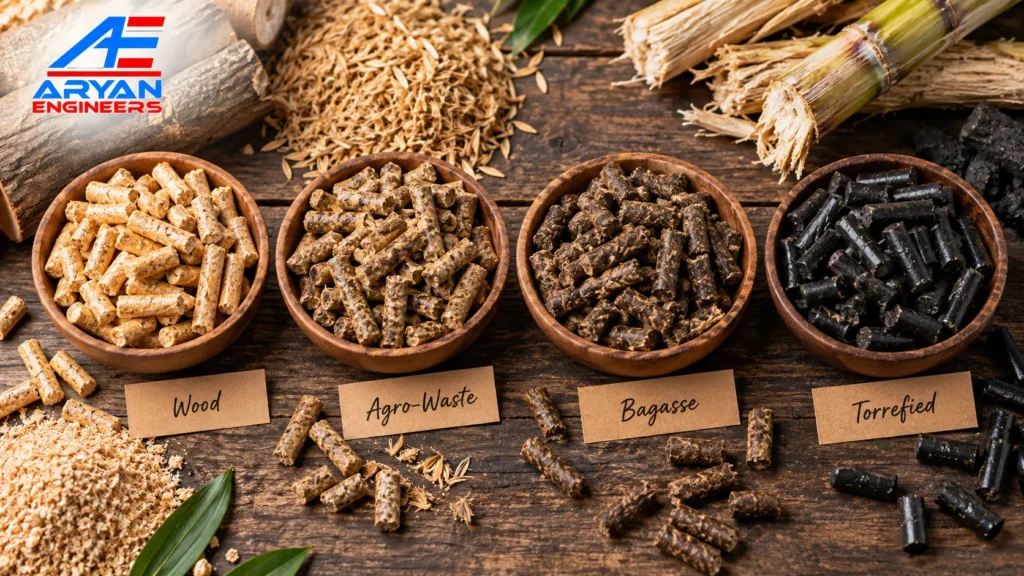
Every serious biomass pellet manufacturer follows a similar sequence. Quality differences come from how well each stage is controlled.
| Stage | What Happens | Why It Matters |
|---|---|---|
| 1. Raw material collection | Residues like sawdust, husk, and shells are sourced and stored | Consistent feedstock means consistent pellets |
| 2. Pre-cleaning | Stones, metals, and dust are removed | Protects machines and reduces ash |
| 3. Size reduction | Hammer mill or chipper grinds material to fine particles | Uniform particle size improves density |
| 4. Drying | Moisture is reduced, ideally below 15% for good pellet formation | Wet raw material gives weak, crumbly pellets |
| 5. Conditioning | Material is blended, steam added if required | Softens lignin for better binding |
| 6. Pelletizing | Ring die or flat die press forms pellets | Pressure of about 200–400 MPa forces material through die channels |
| 7. Cooling and screening | Counterflow cooler lowers temperature; fines removed | Hardens pellets and improves durability |
| 8. Packing | Bagging or bulk loading | Prevents moisture re-absorption |
Heat generated during pressing softens the lignin and resins in biomass, which act as natural binders. So most pellets need no chemical binder, which keeps them clean-burning.
Types of Biomass Pellets and Their Specifications
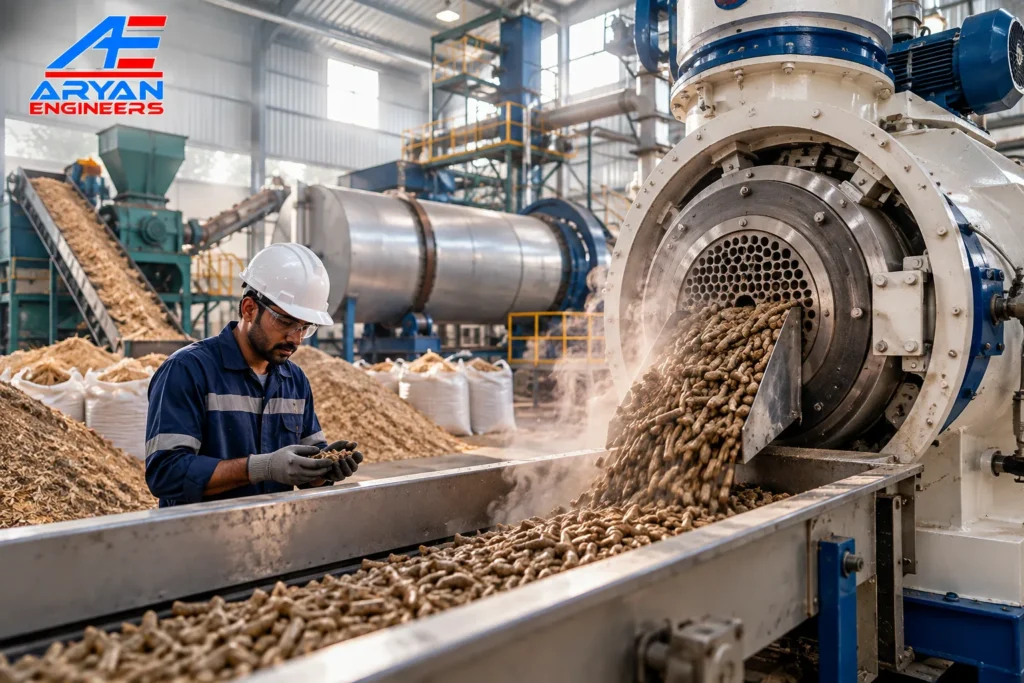
Different feedstocks give different performance. A knowledgeable biomass pellet manufacturer will recommend the type that suits your boiler.
Wood and Sawdust Pellets
Highest calorific value and lowest ash. Best for premium heating and sensitive boilers.
Agro-Waste Pellets
Made from rice husk, mustard husk, groundnut shell, soybean husk, and similar residues. They cost less but have higher ash.
Bagasse and Sugarcane Pellets
Strongly relevant in Maharashtra, a major sugarcane state.
Torrefied Pellets
Heat-treated biomass with higher energy density and water resistance. These are preferred for power plant co-firing.
| Pellet Type | Typical GCV (kcal/kg) | Ash Level | Best For |
|---|---|---|---|
| Wood pellets | 4,200–4,800 | Low | Boilers, heating, premium use |
| Agro-waste pellets | 3,200–3,800 | Medium–High | Industrial boilers, cost savings |
| Mixed biomass pellets | 3,400–4,200 | Medium | General industrial use |
| Torrefied pellets | 3,400–5,000 | Low–Medium | Power plant co-firing |
GCV ranges are based on published Indian market data. Always request a lab test for your specific lot.
Key Quality Parameters to Check
- Gross calorific value (GCV): Most industrial boilers need at least 3,400 kcal/kg, while co-firing contracts often require above 3,800 kcal/kg.
- Moisture: Below 10–14% for most applications
- Ash content: Lower ash means less clinker and cleaning downtime
- Durability: Pellets should not crumble during handling
- Diameter and length: Must suit your feeding system
Biomass Pellet Price in India
Price is the first question buyers ask any biomass pellet manufacturer. Prices in India currently range from about ₹5,000 to ₹16,000 per tonne depending on grade.
| Factor | Effect on Price |
|---|---|
| Feedstock type | Wood pellets cost more than husk or straw pellets |
| Calorific value | Higher GCV commands a higher rate |
| Order volume | Bulk contracts cut the per-kg rate |
| Distance | Transport adds materially to landed cost |
| Season | Raw material cost rises after harvest cycles and monsoon |
| Torrefaction | Adds processing cost but raises quality |
How to compare fairly: Never compare price per tonne alone. Compare cost per 1,000 kcal. A cheaper pellet with low GCV and high ash can cost more in the boiler than a premium one.
Simple formula: Cost per 1,000 kcal = (Price per kg ÷ GCV in kcal/kg) × 1,000
For small buyers, retail rates can be ₹12–14 per kg, while bulk rates fall sharply. Ask every biomass pellet manufacturer for a landed rate that includes GST and transport.
Biomass Pellet Manufacturer in Maharashtra
Maharashtra is one of India’s most promising states for pellet production and use. It has abundant agri-residue, a large industrial base, and strong policy support.
Why Maharashtra Stands Out
- Heavy sugarcane, soybean, cotton, and groundnut output provides steady raw material
- Dense industrial clusters across Pune, Nashik, Aurangabad, Kolhapur, and Nagpur
- A state-specific bamboo biomass blending mandate was notified in December 2025, backed by ₹13,331 crore in government incentives
A biomass pellet manufacturer in Maharashtra has a logistics advantage when delivering to local textile, food processing, pharma, and chemical units. Shorter transport means lower landed cost and fresher stock.
Industries in Maharashtra That Commonly Use Pellets
- Sugar and distillery units
- Textile processing and dyeing
- Food and dairy plants
- Paper and packaging
- Pharmaceutical and chemical manufacturing
- Brick kilns and ceramics
Biomass Pellet Manufacturer in Pune
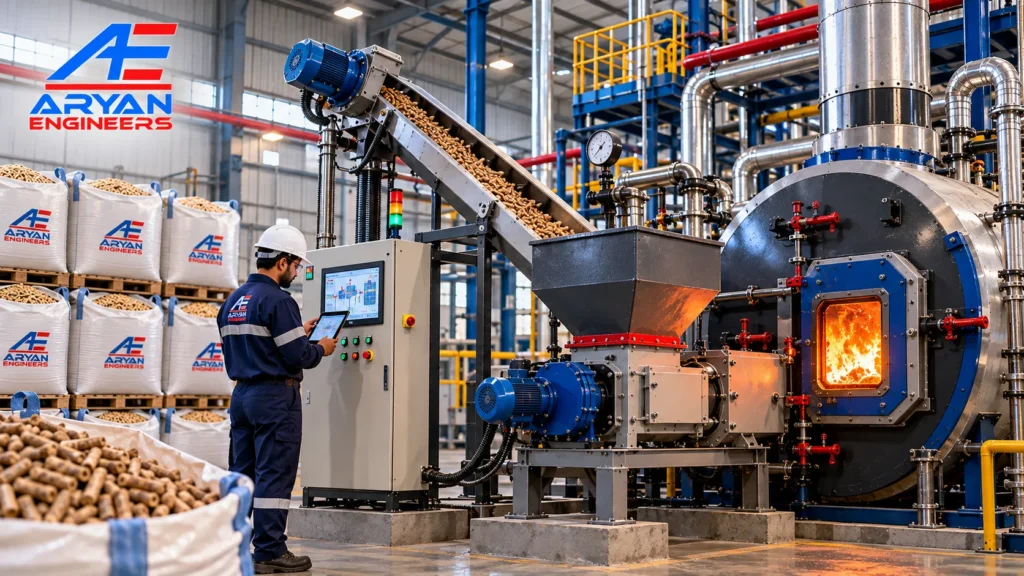
Pune’s mix of automobile, engineering, FMCG, pharma, and IT-park infrastructure creates steady fuel demand. Many Pune plants run steam boilers, thermic fluid heaters, or hot-air generators that can switch to pellets.
Why Work with a Local Biomass Pellet Manufacturer in Pune?
- Faster delivery: Short routes reduce lead time and breakdown risk
- Easy site visits: You can inspect the plant and sample quality in person
- Quick technical support: Local teams respond faster if a boiler issue occurs
- Lower logistics cost: Less diesel in transit means a lower landed rate
[EDIT] Add 2–3 true facts about Aryan Engineering Works here, such as plant location, capacity, years of experience, or machinery supplied. Specific, verifiable details improve E-E-A-T.
Looking for a trusted biomass pellet manufacturer Pune buyers rely on? Check the points in the next section before you finalise anyone.
How to Choose the Best Biomass Pellet Manufacturer in India
Use this checklist when evaluating any biomass pellet manufacturer.
1. Ask for Lab Test Reports
Request GCV, moisture, ash, and durability reports from a recognised lab, preferably for recent batches, not a one-time sample.
2. Inspect the Plant
A genuine manufacturer will welcome a visit. Look for covered raw material storage, working dryers, a cooler, and clean packing.
3. Verify Capacity and Reliability
Ask about monthly output and backup raw material arrangements. A supplier with strong feedstock sourcing avoids mid-contract shortages.
4. Check Consistency, Not Just a Sample
Many buyers get a perfect sample and a poor regular supply. Insist on batch-wise quality commitments in writing.
5. Compare Total Cost
Evaluate landed price, GCV, ash disposal cost, and boiler efficiency together.
6. Confirm Technical Support
The best partners help with burner settings, feeding systems, and storage practices.
7. Review Compliance and Documents
Look for GST registration, pollution control approvals, and fire safety compliance.
| Evaluation Criteria | Strong Supplier | Weak Supplier |
|---|---|---|
| Test reports | Batch-wise, lab-certified | Only one old report |
| Plant access | Open visits | Excuses or no address |
| Pricing | Transparent, GST and freight clear | Hidden charges |
| Supply | Contract with schedule | “Will try our best” |
| Support | Technical team available | Sales-only contact |
Applications of Biomass Pellets
A single biomass pellet manufacturer can serve very different customers:
- Industrial boilers: Steam generation in textile, food, and chemical units
- Thermic fluid heaters: Process heating
- Power plant co-firing: Blended with coal to meet policy targets
- Hot-air generators and dryers: Agro-processing and spice drying
- Commercial kitchens, hotels, and hospitals: Clean heating and cooking
- Brick kilns and ceramic units: Lower fuel cost
- Pellet stoves: Domestic and institutional heating
Biomass Pellets vs Coal, Firewood, and Diesel
| Parameter | Biomass Pellets | Coal | Firewood | Diesel/LPG |
|---|---|---|---|---|
| Cost | Moderate, stable | Low but volatile | Low, inconsistent | High |
| Calorific value | Consistent | High | Variable | Very high |
| Ash and residue | Low–medium | High | Medium | None |
| Carbon footprint | Low, renewable | High | Medium | High |
| Handling | Easy, automatic feeding | Dusty | Bulky | Easy |
| Policy support | Strong | Declining | Limited | Limited |
Advantages of Choosing a Quality Biomass Pellet Manufacturer
- Lower fuel cost than diesel and LPG
- Cleaner combustion and lower emissions
- Uniform size allows automated feeding
- Compact storage and easy transport
- Supports ESG and sustainability goals
Challenges to Know Before You Buy
An honest guide should also cover the downsides. Knowing them helps you negotiate better with any biomass pellet manufacturer.
- Quality variation: Poor suppliers mix low-grade material and add excess fines
- Moisture absorption: Pellets must be stored dry, or they swell and disintegrate
- Higher ash in agro-pellets: Requires more frequent cleaning and boiler adjustments
- Seasonal price swings: Raw material availability affects rates
- Boiler compatibility: Some boilers need burner or feeder modifications
How to reduce risk: Sign a contract with quality limits, test each delivery on arrival, and keep a covered storage area.
Starting Your Own Biomass Pellet Plant
Many readers also search for plant cost and machinery. If you plan to become a biomass pellet manufacturer yourself, here is a quick overview.
| Plant Category | Throughput | Approx. Annual Capacity |
|---|---|---|
| Small | 500–1,000 kg/hr | 4,000–8,000 TPA |
| Medium | 1–3 TPH | 8,000–24,000 TPA |
| Large | 3–10 TPH | 24,000–80,000 TPA |
Based on Indian project-feasibility benchmarks for pellet plants.
Cost indicators: A government planning document placed equipment pricing at around ₹50 lakh per TPH for non-torrefied pellet machinery and ₹60 lakh per TPH for torrefied. Total project cost also includes land, shed, power, dryer, storage, and working capital.
Key Points for New Entrants
- Secure a steady raw material catchment before buying machines
- Choose ring die technology for larger, continuous capacity
- Plan fire safety, dust control, and covered storage
- Register on the SAMARTH platform if targeting power plant supply
For machinery, process design, or turnkey support, explore our related guides below.
Frequently Asked Questions (FAQs)
What does a biomass pellet manufacturer do?
A biomass pellet manufacturer collects agricultural or forestry waste, dries and grinds it, and compresses it into dense pellets. These are sold as clean fuel for boilers, furnaces, and power plants.
Who is the best biomass pellet manufacturer in Pune?
The best choice depends on your fuel needs. Look for a supplier with batch-wise lab reports, an inspectable plant, consistent GCV, transparent pricing, and local technical support. Always request a site visit and a trial lot.
What is the price of biomass pellets per kg in India?
Bulk prices usually fall between ₹5 and ₹16 per kg (₹5,000–₹16,000 per tonne), depending on feedstock and calorific value. Small retail quantities cost more. Compare cost per 1,000 kcal for a fair view.
Which biomass pellet is best for industrial boilers?
Wood pellets give the highest GCV and lowest ash. Mixed biomass or agro-waste pellets suit cost-sensitive plants. Choose the type your boiler design supports.
What raw materials do biomass pellet manufacturers use?
Common feedstocks include sawdust, wood chips, rice husk, mustard husk, groundnut shell, coconut shell, bagasse, wheat straw, and corn stalks.
Are biomass pellets environmentally friendly?
Yes. They use agricultural waste that might otherwise be burned in open fields, and they release lower net carbon than coal. Properly made pellets also burn cleaner than raw wood or loose husk.
What GCV should good biomass pellets have?
For most industrial boilers, 3,400 kcal/kg or higher is a practical minimum. Wood pellets often reach 4,200–4,800 kcal/kg.
How should I store biomass pellets?
Keep them in a covered, dry, ventilated area off the ground. Moisture causes pellets to swell and crumble.
Is there a biomass pellet manufacturer in Maharashtra that supplies in bulk?
Yes, several operate across Maharashtra. Confirm monthly capacity, delivery schedule, and quality guarantees in writing before placing a large order.
How much does a biomass pellet plant cost in India?
Equipment alone can start near ₹50 lakh per tonne-per-hour of capacity, with total project cost higher after land, civil work, utilities, and working capital.
Conclusion and Get a Free Quote
Choosing the right biomass pellet manufacturer saves fuel cost, protects your boiler, and supports your sustainability targets. Focus on lab-tested quality, consistent supply, transparent pricing, and reliable support, whether you are buying in Pune, anywhere in Maharashtra, or across India.
The market is growing quickly, and quality gaps between suppliers are real. A careful evaluation now prevents costly downtime later.
Get a Free Quote Today
Need pellets, machinery, or plant guidance? Speak to our team at Aryan Engineering Works for specifications, pricing, and technical support.
Call: 9075416505 / 9209059160
Email: aryanengineers195@gmail.com
Website: aryanengineeringworks.in